The Art and World

of


Quintanilla's signature


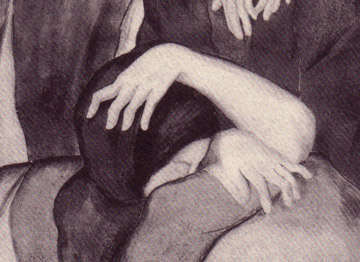
Detali from Five Women 1940s


The Art and World of Luis Quintanilla. This retrospective web gallery features selections from the life’s work of the Spanish artist, Luis Quintanilla. (1893-1978) As organized and arranged by the artist's son, Paul Quintanilla.


Chronology of Quintanilla's Life and Work

The Murals | Portraits | Drawings and Engravings

Still Lifes | Landscapes and Interiors

Illustrations for Books and Plays | Water Colors

Pastels | Modernism | Old Age

Shows | LQ's Memoirs & Biography | Selected Bibliography

Quintanilla Photographs | A Little About Quintanilla

A Brief Aesthetic Survey of Quintanilla's Development

More on this Site

Or Scroll Down


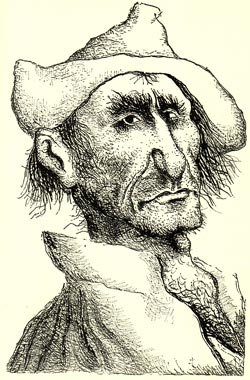
Gulliver's Watch


The Murals

A Little About His Murals

Love Peace Hate War

Don Quixote in the Heartland

Love Peace Hate War


Carl Van Doren

Portraits

Portraits of the Family

Portraits of Friends

The Portraits of Writers as How They
See Themselves

Hollywood Personalities

The New Yorker Profiles

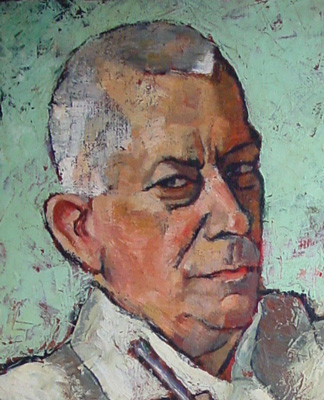
Portraits of the Artist

Companions in Jail

And Fascists


Drawings and Engravings

The Etchings of Madrid Life and Street Scenes

Jail from the Inside

The Drawings of the War

Franco's Black Spain

New York Drawings and Engravings

Studies and Sketchbooks


Etching


Flowers

Still Lifes

The 1940's

The 1950's


Landscapes and Interiors

The 1950's

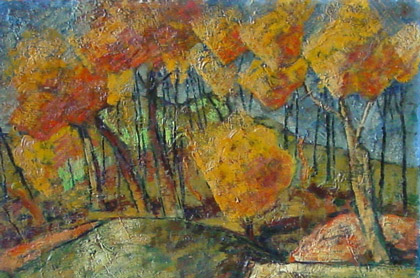
Detail Autumn in Woodstock


Three Exemplary Novels


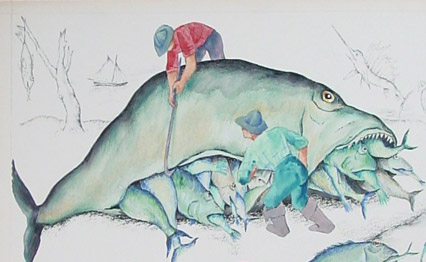
The Big Fish Eats the Little Fish


Pastel of a Man and a Woman


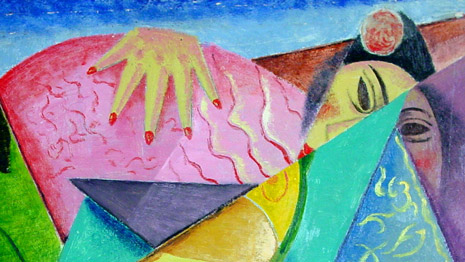
Cubist Painting


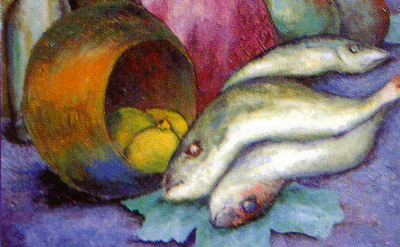
Still Life with Fish


Quintanilla Photographs

During the War


gulhoun


A Little About Quintanilla (1893-1978)

Starting out as a Cubist under the influence of his friend, Juan Gris, Quintanilla eventually became a prominent Spanish draftsman and muralist. Though he would have far preferred to be left alone to paint in peace without engaging in politics he was eventually drawn into the tumultuous affairs of his times. In 1931 he and Juan Negrin, the Premier of the Spanish Republic during the Spanish Civil War, put the flag of the Republic up on the Royal Palace in Madrid ensuring that the revolution which ousted the king would remain bloodless. In October of 1934 Quintanilla started a prison term lasting eight months, four days, and three hours for hosting, in his studio, the revolutionary committee of the October revolt. As has happened on other occasions when a prominent artist has found himself in jail, the world's intellectual community rallied to his aid. Ernest Hemingway and John Dos Passos circulated the petitions and organized the protests in the United States, Andre Malraux in France, and Lady Margo Asquith, wife of the former Prime Minister, performed the same service in Britain. And a show of his Madrid street scene etchings took place at the Pierre Matisse Gallery in New York with a catalog by Hemingway and Dos Passos. This show introduced him to the United States. When the Spanish Civil War started in July, 1936, Quintanilla helped lead the attack on the Montana Barracks which saved Madrid for the government. He was made the commander of the barracks at the start of the war and led men in action on the streets of Madrid, Toledo, and in the Guadarrama Mountains. In the spring of 1937 he was removed from these and other duties by Juan Negrin and commissioned to do a set of drawings of the war. These were shown first in 1938 at the Barcelona Ritz and then in the Museum of Modern Art in New York with a catalog by Hemingway. With the fall of the Spanish Republic in 1939 he was forced into an exile which lasted more than 37 years, living first in New York and then in Paris. A year following the death of Spain's dictator, General Francisco Franco, Quintanilla returned to Madrid where he spent the remaining two years of his life. He died at the age of 85.

Paul Quintanilla


A Very Brief Aesthetic Survey of Quintanilla's Development


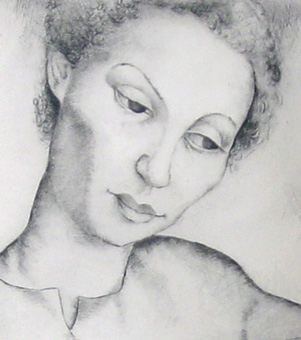
Detail Juanita


Start Here -

1 - Cubism---Modernism

2 - Murals

3 - Etchings

His style always adapted to his theme. Though

he made the drawings of jail soon after the Madrid street scenes

note how different they are. And how they capture an entirely different spirit and mood.

4 - Jail Drawings

And once again his style adapted to his theme.

5 - War Drawings

Further examples of how his approach and style adapted can be

seen in all his other drawings and illustrations. On the Main Menu there are many links.

6 - Love Peace Hate War and Don Quixote Murals

7 - These links (New York and Paris) will take you to the Main Menu.

Most of my reproductions are of work from the forties and fifties, what is

in my own collection. He may have reached his prime in Paris

during the sixties. Unfortunately, I have very few reproductions of

his work from that time. Nor do I know where most of it is today.

New York and Paris

Old Age


"The transcendence of a genuine artist can be understood by any person who merely looks at the extraordinary results of converting a wall, a tablet, a canvas, or a flat board into something with lines and colors which the whole of humanity can admire and look at over many centuries, art being the one eternal value which helps us endure the stormy upheavals of history."

Luis Quintanilla

Translated from Pasatiempo: la vida de un pintor


In a century which greatly prized individuality, even eccentricity, for its own sake, Quintanilla paid a very high price for going his own artistic way. He was modern without truly becoming a Modernist, and he never signed that most modern of artistic credos which declared aesthetics null and void. As he tells us in an open letter he wrote to Ernest Hemingway for his 1939 Associated American Artists' Gallery show, "I believe only in good painting. Abstract or concrete, with ismo or without ismo, come from where it might and go where it will.” This letter could well serve as his own artistic credo and an introduction to his work.


Paul Quintanilla


More on this Site


Rabelais

This homemade, cardboard sign was attached to a corner of the wooden bin my father constructed and used in his New York studio to store his oil paintings. The quote from Rabelais is, of course, bogus. The sign was merely intended to keep visitors from freely picking through the paintings, which irritated my father.

Be assured, though, that this "Stay Away" sign doesn't apply to visitors to this site. There is, I believe, a wealth of art work here, all of it neglected and much has never been displayed before.

Paul Quintanilla


About this Site

Pablo CasalsThis web gallery features reproductions from my own collection of Quintanillas. These include: the etchings of Madrid street scenes Ernest Hemingway and John Dos Passos presented at the Pierre Matisse Gallery in 1934, which Hemingway characterized as “the best dry points I have ever seen by anybody living:” the drawings Quintanilla did of his companions in jail in 1934: his drawings of the Spanish Civil War which were shown in 1938 at New York’s Museum of Modern Art and were later reproduced in All the Brave, with commentaries by Hemingway, Elliot Paul, and Jay Allen: his Love Peace Hate War murals, which were commissioned by the Republic for the 1939 World’s Fair: portraits of a few of his many friends, including Hemingway, Pablo Casals, and Robert Flaherty: his fanciful series of never-seen-before portraits of American writers as “how they see themselves,” including Dorothy Parker, John Steinbeck, William Shirer, Elliot Paul, John Dos Passos, Richard Wright, and Lillian Hellman among others: as well as a sampling from a large and diverse collection of water colors, illustrations, still lifes, studies, landscapes, etchings, portraits, and lithographs.


More on this Site or scroll up
Main Menu or scroll up


Top